

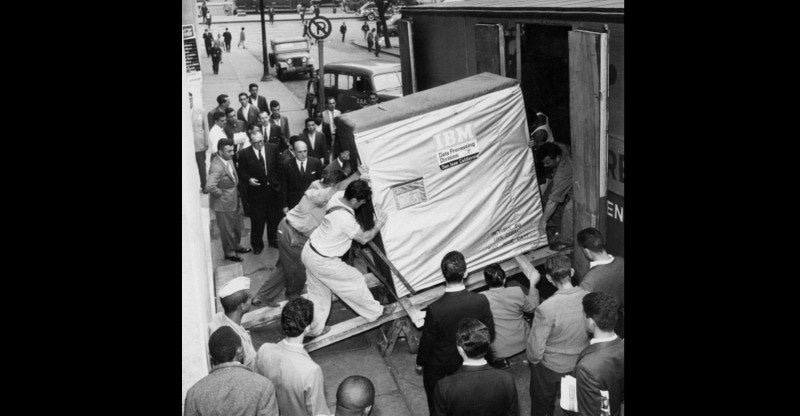
A 5MB hard drive being shipped by IBM in 1956.
Media ecologist Marshall McLuhan once said that “the content of every new medium is the previous medium.” Conceptually, I find this very difficult to get my head around. Thanks to K Allado McDowell, I have made it at least half way. K Allado McDowell is an artist, musician, neuro-operatic composer, essayist/author and established the Artist and Machine Intelligence program at Google in 2015. In this brief essay, I will outline the framework they have created that sheds light on the transformation of media and technology between the period of 1920 to present day.
McDowell defines four distinct tri-decade periods that span the modern/post modern period. From 1920 to 1950: Broadcast Media. From 1950 to 1980: Immersive Media. From 1980 to 2010: Networked Media. And we are half way through a new, still emerging period they call Neural Media. Each media type is characterized by three fundamental elements of space, content and identity.
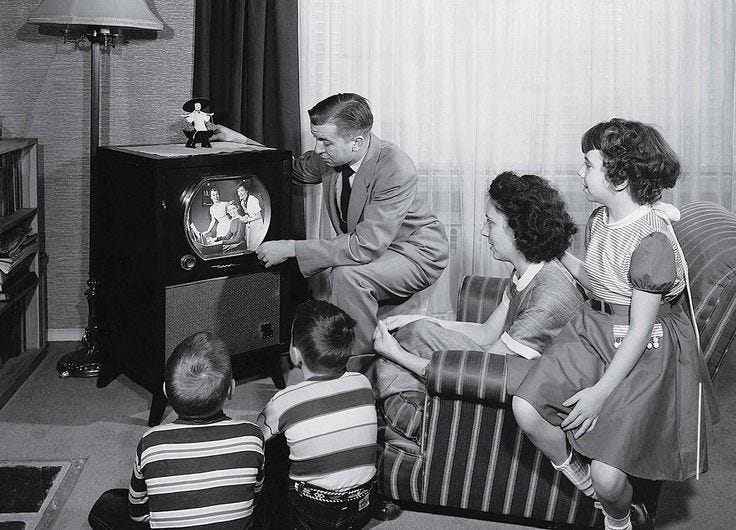
I am old enough to remember black and white television. I was often warned that sitting in front of it for too long would “warp my brain.”
Broadcast Media began around 1920 with the advent of home radio and by 1950 television became the dominant media form. Broadcast Media occurs in a centralized space, its content is programmatic and it imparts or informs demographic identities. It is a “one to many” transmission which trains the viewer to a single message. Content, delivered by public personas such as credible news anchors, comedians, various characters and celebrities, were partitioned into standardized time blocks. The portrayal of families, women, and persons of color in these programs shaped social norms and cemented ideologies, particularly in the post-war period. The first “sensing” of audience was developed by the Neilson Group that created a device that would monitor televisions in people’s homes and create crude data for advertisers.
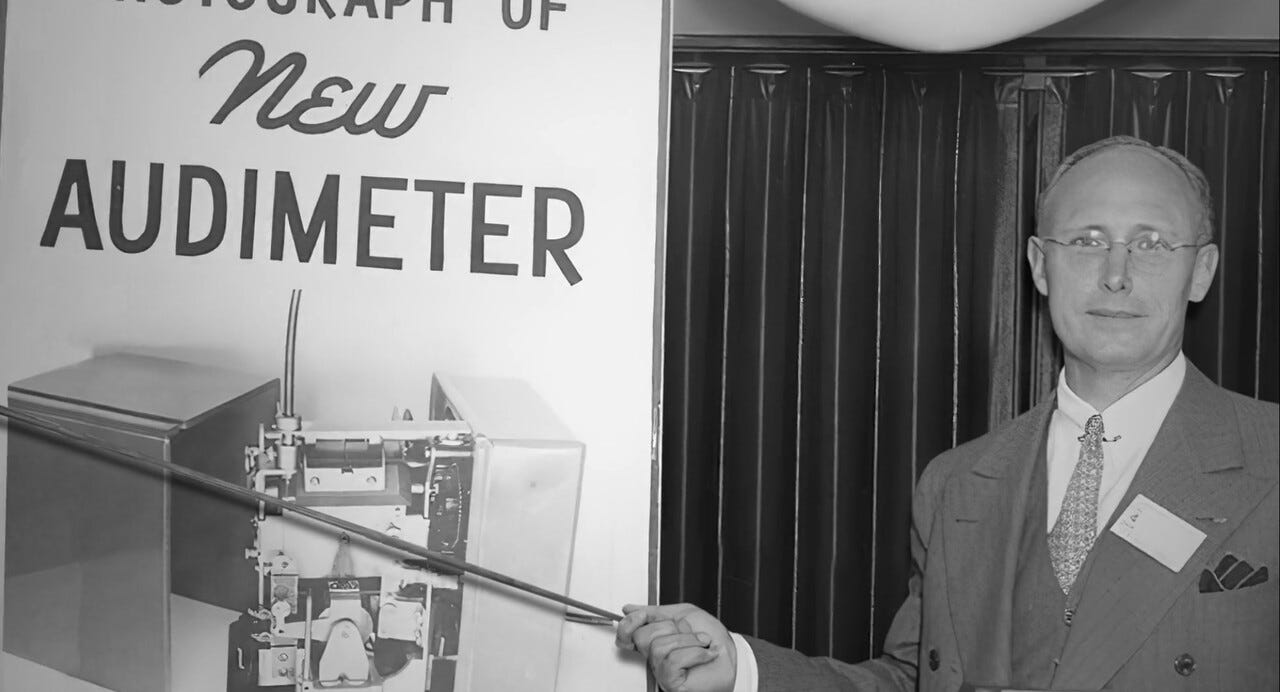
The audimeter was a device that gathered the first reliable data on television consumption. The data was crude, with gender split into four age groups and several income brackets. It was the precursor of today’s surveillance economy.
During the Roosevelt administration, The Committee for Public Morale was established. Led in part by anthropologist Margret Mead and social psychologist Erich Fromme among others, the goal was to create a national propaganda agency to compete with Germany’s Reich Minister of Propaganda, Joseph Goebbels. What the committee ultimately recommended was a “democratic surround,” offering a broader world perspective and often involving multiple media displayed in dome-like art installations, both on american soil as well as in non-politically aligned international venues.
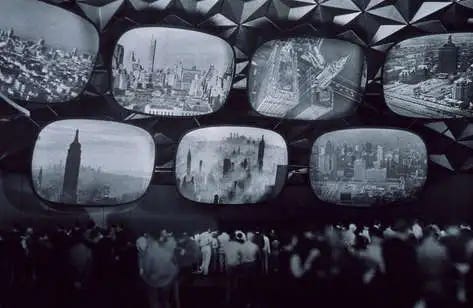
Above are artists Charles and Ray Eames’ installation at the 1959 Cultural Exchange between the US and USSR in Moscow. The Eames’ were tasked by the US government to create a multi-media exhibit which randomly displayed 2,200 images of the everyday life of an American citizen. Note the dome structure above the monitors. The term “democratic surround” was coined by Fred Turner, professor of Communication at Stamford University.
The efforts of this committee in large part ushered in a shift to what McDowell calls Immersive Media, utilizing a distributed space, offering experiential content and encouraging constructed identities. Such installations often combined an industrial, military and political ethos, oddly intertwined with images of different people and places from all over the world intended to instill a sense of human commonality, understanding and tolerance. Where Broadcast Media or “one to many” was correlated with fascist indoctrination, this new immersion or “surround” invited the viewer to explore an open and distributed space, often globally situated within a dome structure, in order to dissolve enough ego-centrism to insinuate oneself into a more open and cross-cultural mindset. In my view, these media perhaps acted more as an ideological solvent than a pre-formed social mold. I would argue that the CPM’s vision for a new way of thinking resonated strongly with one particular group of American youth and gave rise to the counter culture’s turgent revolution of the 60’s. Programmatic content became more flexible and open to interpretation. Identities were more lucidly formed by the now informed and internal psyche of the individual.
It's important to note here that there isn’t a hard stop and start between the dominance of each media type, rather, one evolves slowly and stealthily into something new, almost always due to advances in technology. One such advancement was Moore’s Law, an exponential doubling in computational power every two years which in the early 2000’s led to the “dome” spreading out through our interconnected devices inside digital ecosystems all about us. Network Media is the result and it begins in the 80’s with the nascent internet and fully flowers by 2010. In Network Media, the space is circulatory, the content is memetic (or viral) and the identities are fractal. The transmission is “many to many,” bi-directional and fluid. Within this web of technology, identities may change and develop over time as the media is in constant flux, derived from multiple perspectives and often extremist and confrontational. Network Media creates rabbit holes and echo chambers, viral phenomenon and a cosmology of alternate beliefs that make Buckminster Fuller’s hippie communities of the 60’s look like stalwarts of conformism. One day, you’re are a card carrying liberal and the next an anti-woke conservative. All the while the big tech five, Apple, Google, Facebook, Amazon and Microsoft through digital mining have created a “meta-audimeter” that knows your gender, age, income, location, political leanings, musical taste, sexual preference, etc. All of this data is then used to predict and display objects and services that the model thinks you will buy. This is our current state of surveillance capitalism and as McDowell points out where the audimeter monitored your television set, the system itself is now sensing you directly.
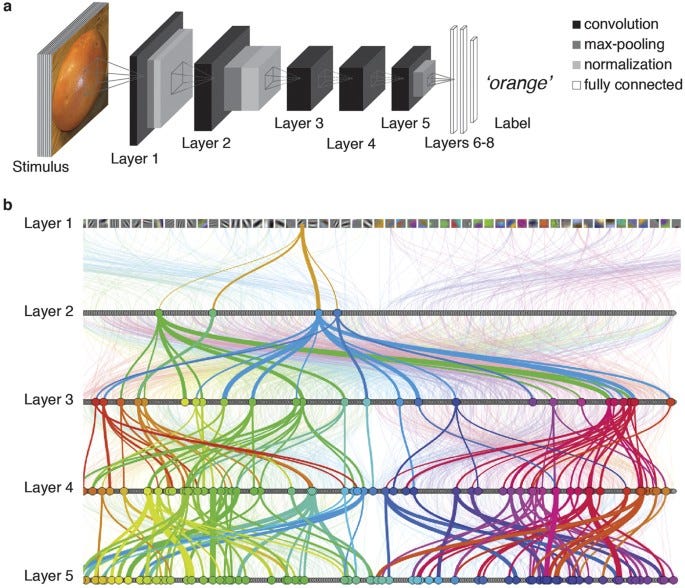
The graphic above shows the layers of steps by which an AI model is trained to identify images. Many neuroscientists are beginning to see similarities between machine learning models like these and biological brain functioning.
In their futurist and speculative style, K Allado McDowell plausibly proposes that we are now transitioning into what they call Neural Media, where the space is high-dimensional, the content is hallucinated (generated) and the identities are embedded. Like every computational system the fundamental mathematics of AI and neural nets is statistical. Each of us is a vector node within a vast and deeply interconnected neural web, a sort of artificial brain capable of functional computation that maps users, and embeds them within the net based on probabilities and distribution. These embeddings in turn influence how we are perceived by it, ourselves and others. Statistical models are used in the major decisions we make throughout our lives. Insurance, home buying, loans, employment, even dating. As human labor is replaced by machine labor, these systems will evolve, but we do not know when or how. Added to this uncertainty is the growing use of biometrics which will also allow neural nets to quantify and qualify our health data as yet another model to be exploited or commoditized.
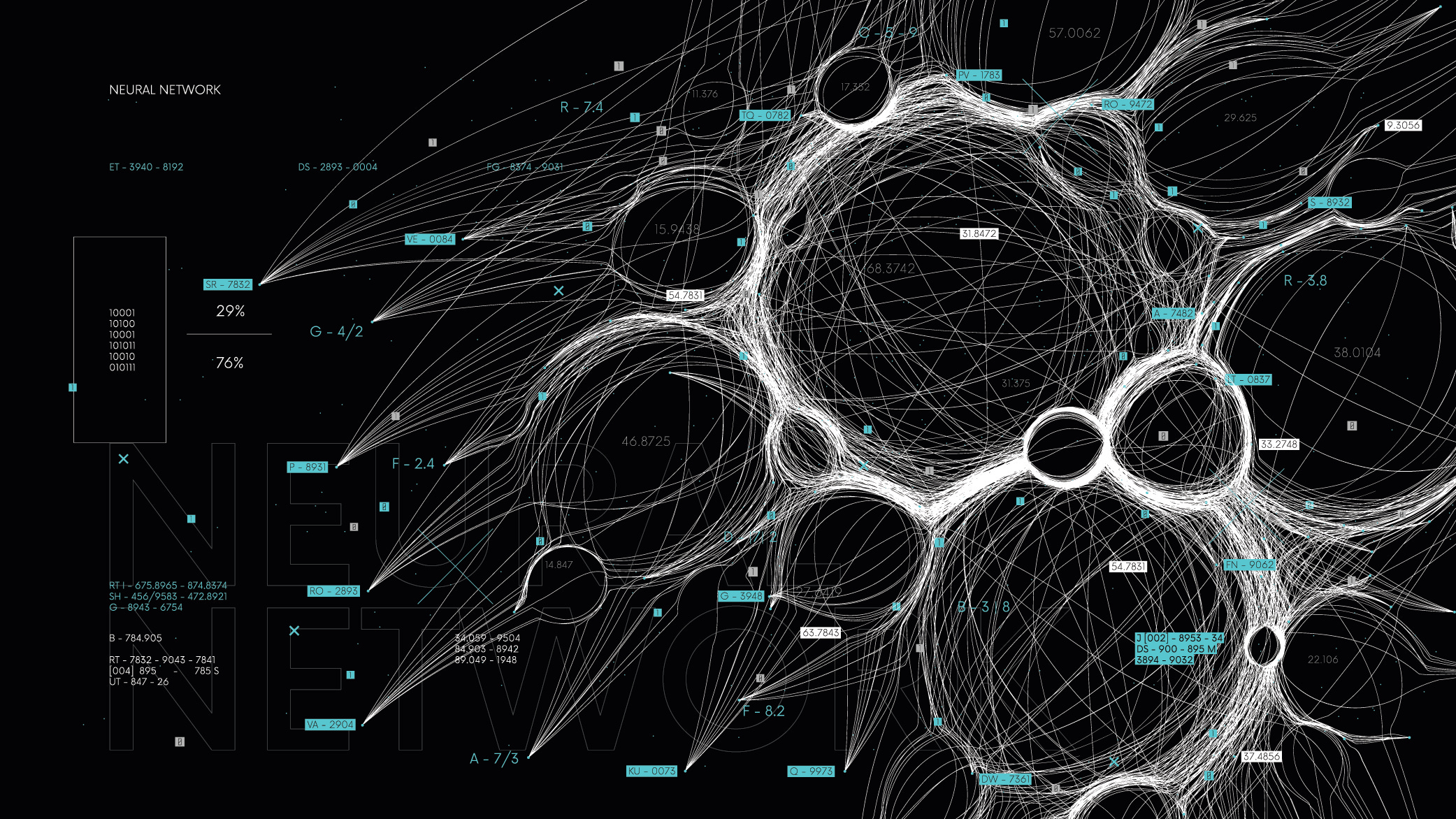
From trentonsystems.com. The second subset of artificial intelligence, neural networks are interconnected computing nodes that operate in a manner similar to neurons in the brain. Most commonly found in GPUs, they utilize algorithms to recognize hidden patterns and correlations in raw data, cluster and classify it, and, over time, continue to learn and improve from it.
Like many other thinkers I am following, K is speculative with a focus on design fiction and experimentation between human and AI systems. In my opinion they are one of the world’s greatest thinkers alive today. McDowell’s vision is one where we train the power of AI and neural nets on forms of life other than humans. Research in biology, neuroscience, physics and many other academic fields are bringing forth the realization that all life is at its core computational. From cellular mitosis to the cognitive architecture of our brains, organic matter is self-forming and it is this autopoeisis that should be our focus for AI alignment. Artificial intelligence is likely to tell us more about intelligence that we tell it. Alignment with humans in the midst of an Anthropocene therefore, risks an over-fitting of short sightedness and a severe lack of guiding semiotics. Language will need to change as adequate nouns to describe our emerging world are in short supply. In our current discourse, we alternately fear that AI is either too much like us or not enough like us. Both assumptions may be wrong and either assumption may cause more harm than good if used for AI alignment. McDowell wants to explore alternatives and perhaps find that less alignment or other-than-human alignment equals more good. In my next post, I will write about The Long Now Foundation, a group I have recently become a member of.
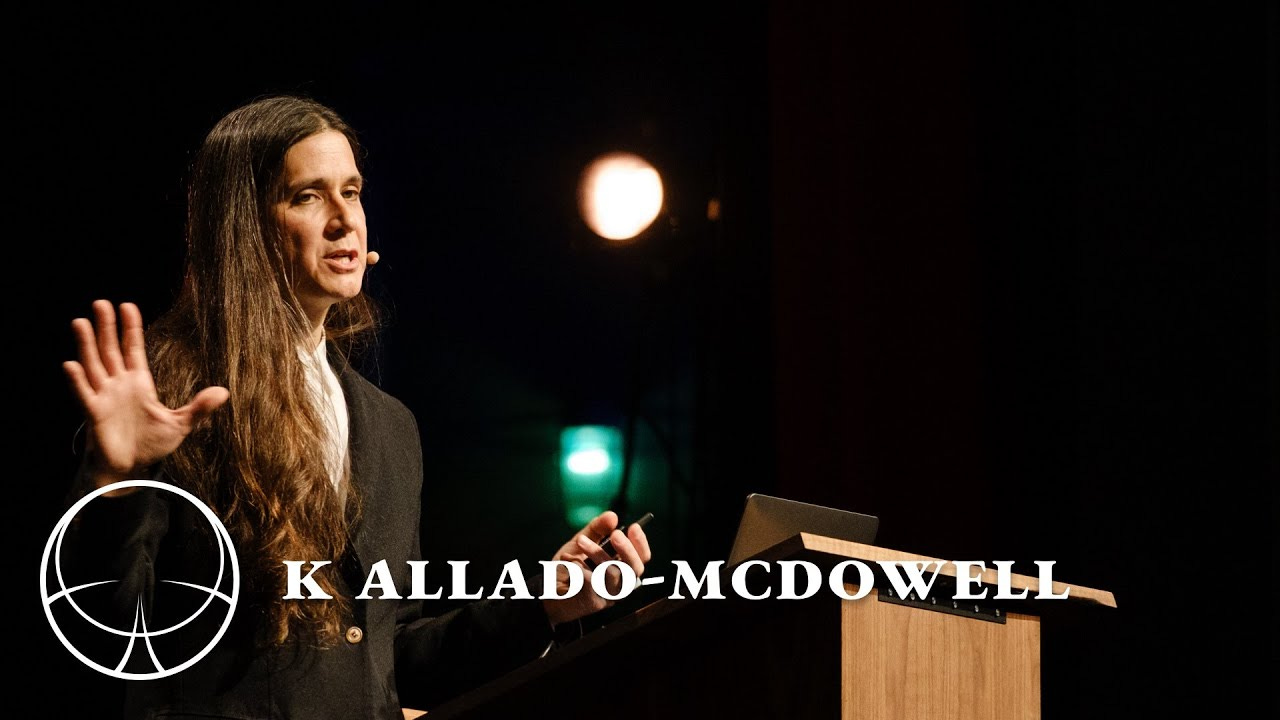
K Allado McDowell delivering a presentation to the Long Now Foundation. K authored a book entitled “Pharmako AI” which they co-wrote with ChatGPT. I have read it and highly recommend it.