


In my last post, Pharmakon By Design: Can We Hack Our Faustian Bargain with Technology, I made a lot of references to the tech space that I absorbed from my studies. In the next series of posts, I will give a review of the academics I have been following. First up, Benjamin Bratton.
Benjamin H. Bratton, PhD., is an American philosopher of technology known for his work spanning social theory, computer science, speculative design, artificial intelligence, and for his writing on "planetary scale computation.” He is Professor of Visual Arts at University of California, San Diego, (from Wikipedia) and author and editor of numerous books and essays. I have read “The Stack: On Software and Sovereignty,” which is the manifesto for a research effort and think tank called Antikythera. The goal of this broadly scoped organization is to bring together academic thought leaders and from philosophy, computer science, biology, music, art, architectural design, chemistry and so on. The multi-disciplinary approach is to create discourse, speculation and perhaps even new language for the future of technology and AI.
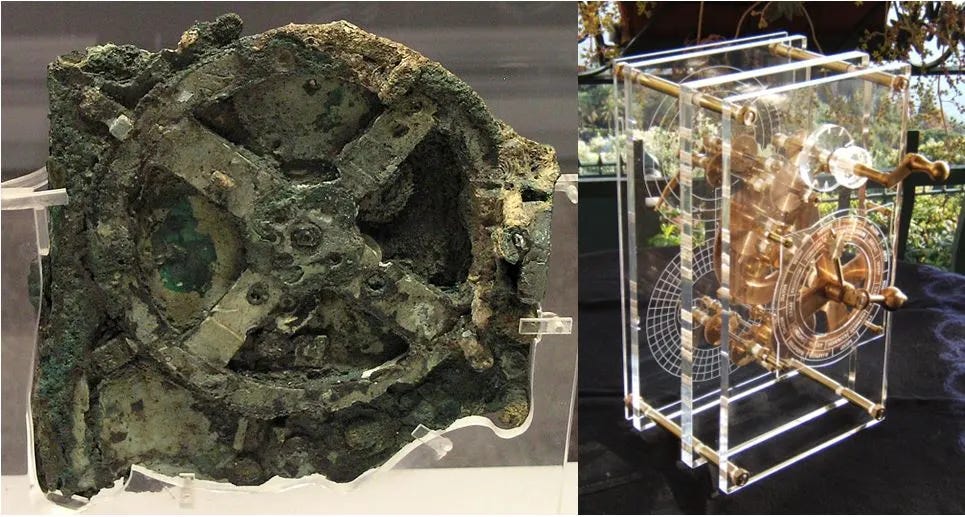
The Antikythera mechanism, discovered off the coast of the Greek island of Antikythera on an ancient sunken ship dating between 70 and 60BC.
Antikythera takes its name from an Ancient Greek device that was used for astronomical calculations, eclipse prediction, calendar display, time keeping and other cyclic events. It was discovered on a shipwreck by a sponge diver in 1901 in the Aegean Sea. The significance of this sophisticated ancient technology is that people were able to track time and space in relation to the movement of the stars and moon. Philosopher Martin Heidegger called this type of technology “existential” because it brought forth an epistemological advance in how humans perceived reality and their relation to space and time. By the 5th century BC, most Ancient Greek scholars believed the world was a sphere, a scientific truth in part elicited by the intricate gear works of the mechanism itself. Mostly due to interpretations of Biblical text, a flat earth resurgence eventually took hold in the Middle Ages, the Antihythera device sunk to the bottom of the ocean, and it would take yet another technology to finally set the cosmological record straight. More on that in the text ahead.
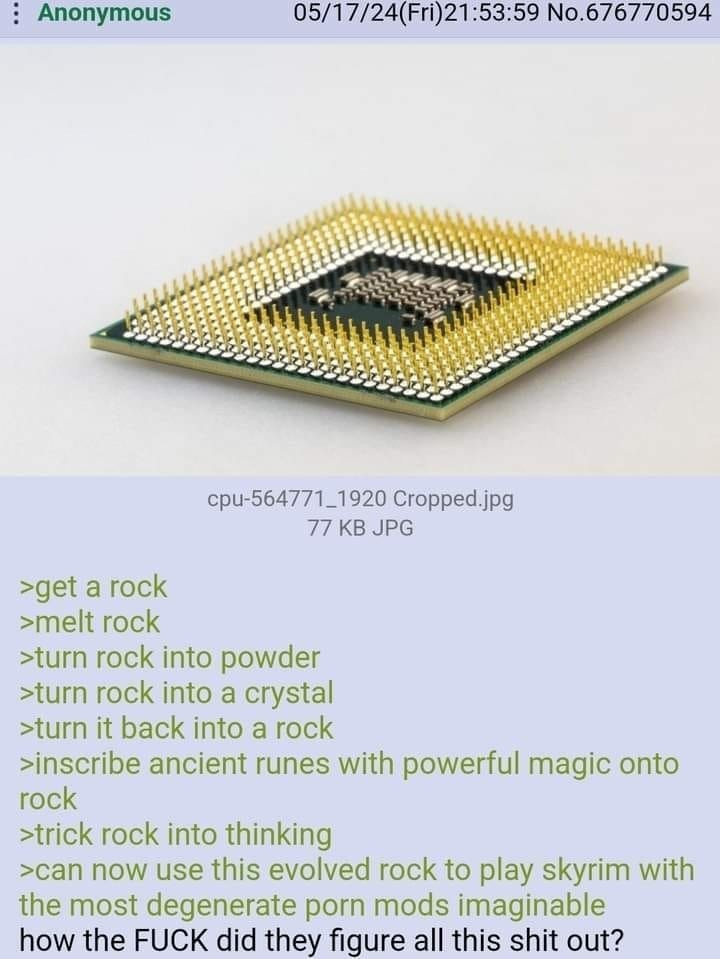
Bratton’s theories of technology straddle the physical and conceptual. He views our current technology as an “accidental megastructure” capable of planetary computation. This tangle of undersea copper and fiber cables, networks of geo-sensors, massive infrastructure for data refinement and modeling (the cloud) and an exoskeleton of satellites (folded minerals) in orbit just outside of the earth’s atmosphere, all have allowed us to understand that our previous technologies have had the negative planetary effect of global warming. And he sees the lithosphere as having evolved along side its human counterpart-parts. In his view, we have made “rocks think” via the silicon, coltan, copper and other minerals we use to create micro-chips containing billions of transistors in the incredible size of one square inch. But these thinking rocks are as existential as it gets. Like the telescope, which once and for all solved the flat/round issue, knowledge of the climate crisis and our part in it, is today’s “Copernican Turn.”
Bratton uses two other cosmological events to make a point about how we see ourselves in relation to the universe. The first is “the blue marble,” a photograph taken of the earth from space by the Apollo 17 crew in 1972. This image put a face on a solitary, fragile and beautiful sphere, only once imagined and now revealed to our raw consciousness. It forced an allocentric mindset on anyone of us with the normal amount of human humility. To others, it depicted a swirl of sovereign nation states, carved out of the Westphalian tradition and susceptible to over-throw or exploitation. Either way, it was a disruption in our thinking and ways of knowing.
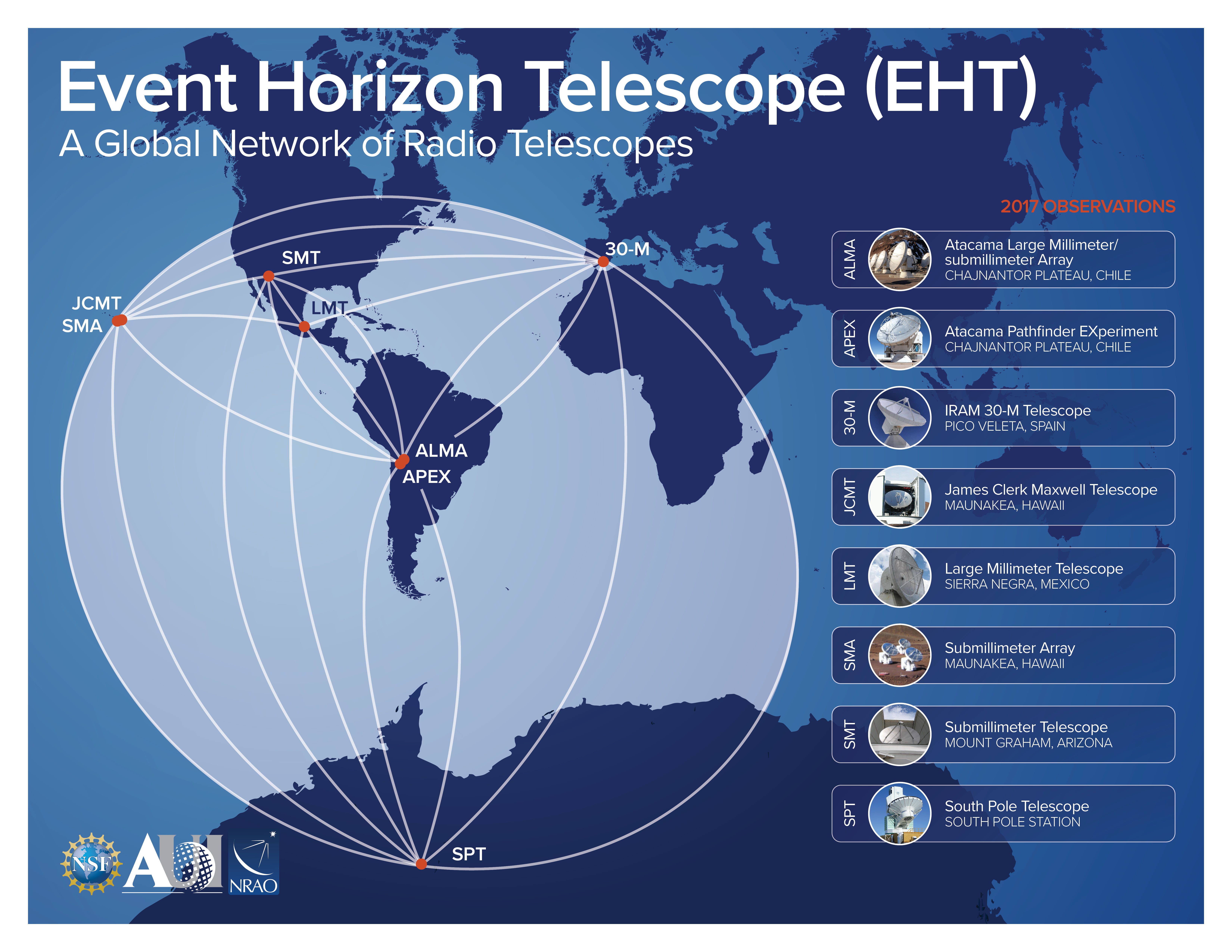
The second is the image of the super-massive M87* black hole generated by the event horizon telescope -a system of 8 coordinated and networked telescopes from around the planet. The rotation of the planet itself was involved in the timing and sequence of each telescope’s deployment, thus, in Bratton’s words “the planet itself is part of the machine.” He concludes that this combination of lithosphere, geosphere, terraformed megastructure and the development of exponential computational power has led to “planetary sapience,” a process through which the planet is actively engaging in self disclosure of its own awareness and epistemology.

M87* is an “event horizon,” a massive black hole over 53 million light years from earth. A networked system of telescopes around the planet were coordinated to capture this image in 2019. Below is a graphic of the “event horizon” telescope system.
But the image of Black Hole is different from that of Blue Marble. Instead of gazing inward and on to our cosmological condition, we have been taken outward and out of, our conscious reality and into the ineffable abyss of nothingness. It’s a Copernican Turn of a different kind. In his typical acerbic style, Bratton makes a distinction between each image’s impact this way. “If Blue Marble implied a global village by putting apex creationists in charge of a mythical garden, Black Hole demands a different planetary regime by rendering humans as a privileged mediating residue that sets in motion further generalized cognition. The two worlds could not be more different. This is a new profile for us and one that will take some getting used to.”
Intertwined with both deep scholarship and H.L. Menckenish critique, Bratton has articulated a “vertical atlas” he calls Hemispherical Stacks. Conceptually, there are six layers to the stack, seen in the illustration below. For the purpose of this writing, it will suffice to say that every layer is embedded within an irreducible planetary whole, each containing some overlapping of raw materials or their offspring (earth), intersecting nodes (interface), computational infrastructure (cloud), human interaction (user), and urban areas (city). More importantly is the impact on geo-political boundaries, sovereignty, power structures and emerging technofuedal economies. Traditional mapping and boundaries of every kind are becoming blurred and redefined with increasing regularity. There are now ghost enclaves and exclaves, invisible to the eye but permeable through consolidated transactional systems, surveillance economies, dark web activities and the supplantation of free market catallaxy.
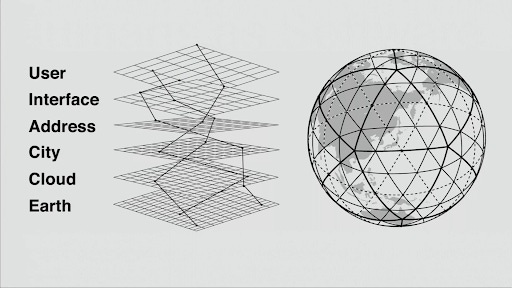
Hemispherical Stacks, a neologism coined and imagined by Benjamin Bratton, PhD.
Bratton is difficult to read. His verbiage and academic coinage is both interesting and confusing. It has required of me a focused study and much re-reading of his ideas and theories and constant cross referencing and use of dictionaries. He is blatantly a pedant and usurper of our current intellectual culture. His scathing attack on Ted Talks is a prime example.
11 years ago, Benjamin Bratton gave this Ted Talk, where he lambasted the platform for its weak discourse on intellectual ideas.
In a Ted Talk himself, he called the platform “middle-brow, mega-church, infotainment.”where personal epiphanies beget insightful, courageous stories for book sales. His most compelling statement here is the call for “more Copernicus, less Tony Robbins,” a decidedly supercilious but not altogether inaccurate critique. I have to say that I was thinking that Ted Talks were a bit on the shallow side myself and found this video to resonate with me in some fundamental way. It’s his call however, for the best thinkers in every field to come together and speculate on our technological future which is certainly warranted and in his words, “quite pressing.” When you consider our current leadership, the “big five” tech oligarchy and a generally under-educated populous, I do agree with his theories and propositions for active and intentional imagining of a “pro-topia.” After dissecting and “trying on” his work, Bratton has become a big influence for me. Delving into his work has enlightened some of my vague generalizations and corrected many of my black/white beliefs about technology that were due to tacit knowledge on the subject. He is worthy of the study.
Thank for reading this Substack post. Next time, I will discuss K Allado MacDowall, an artist, futurist, musician, designer, and author.